
Let Us Cook? Sweltering Heatwaves, No Climate Policy—Because the Public Doesn’t Care? Not So Fast.

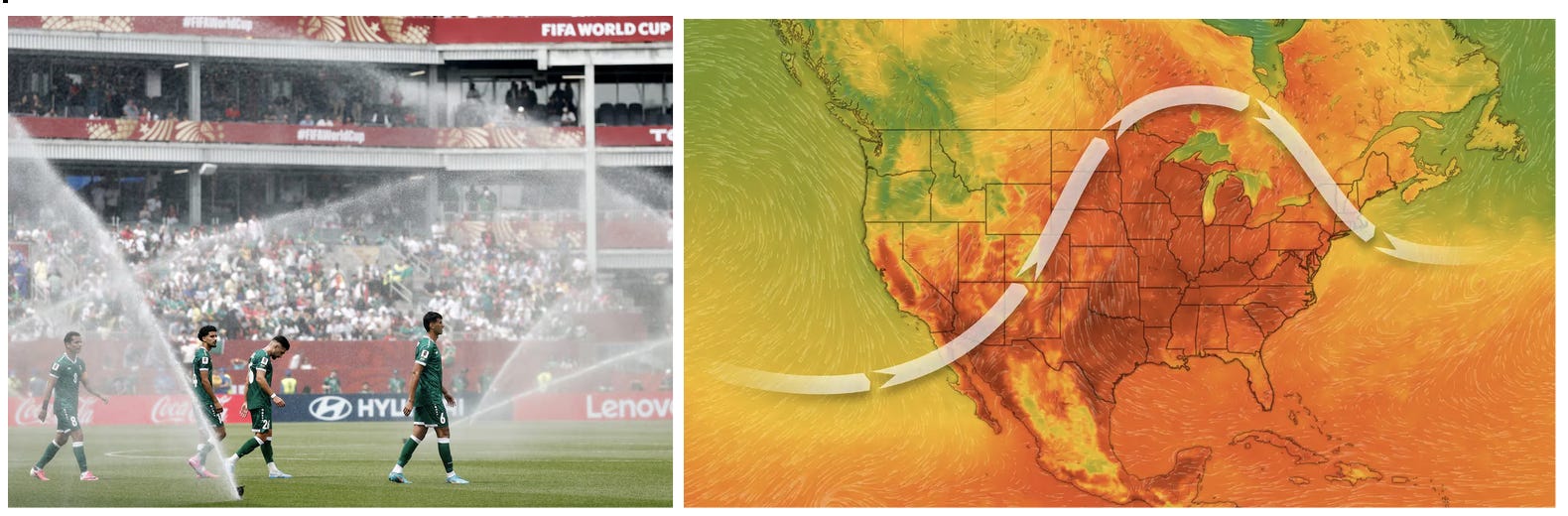
I’ve been enjoying the chaos and joy brought on by the World Cup. Despite everything that FIFA does to monetize and make sleazy backroom deals, the World Cup is still so much fun to watch. The hydration breaks during the game have been rightly ridiculed as a thin veneer for FIFA to add commercials to the game. Commentators have joked that it was inevitable that Americans would warp the beautiful game into a four-quarter affair. But there is a logic behind the hydration break. World Cup games are being played in several outdoor stadiums in the summer in the U.S. in the middle of the afternoon, and it’s hot. Washington DC, and much of the eastern half of the U.S. will experience multiple 100 degree days heading into July 4th as a dangerous heat dome takes hold. As a check of how hot it was, yesterday, July 1st, I put my meat thermometer on our front door that gets partial sun in the afternoon, and it registered 129.7 degrees Fahrenheit at 4 PM.1 I grew up in Texas, but even I can admit it’s brutally hot. Europe also has been sweltering through on and off heatwaves since May, with temperatures 15-25 degrees Fahrenheit above normal. There’s been a lot of discussion about U.S. versus European norms on air conditioning, and who is right from a climate perspective.
But as a political scientist, I am less interested in the air conditioning wars, and more in the fact that we are in the midst of a record heat wave, and there is almost no serious discussion of climate policy, even from Democrats. The folk wisdom is that the public doesn’t care that much about climate change, and that the issue has receded in importance. Voters are more worried about affordability, and climate change is more of an “elite” concern. This is something echoed by several popular commentators, and even left-wing and liberal strategists. Climate is a political loser and nobody cares. The problem with this framing is that it’s wrong. The U.S. public is more worried than ever about climate change and its effects. Yet policy, even among Democratic leaders, is moving backwards—why?
And like that, poof—it’s gone
A strong and consistent finding in political science is that people do respond to weather events and natural disasters. Local temperatures shape people’s perceptions about climate change. Natural disasters also affect attitudes. Wildfire smoke, hurricanes, and floods push people to be more concerned about the environment and climate change, and support climate policy. The problem is these effects are concentrated among people who are already disposed to supporting climate policies. The effects also tend to be small, and decay quickly. Political science provides some clues as to why this is the case. Public opinion is shaped by elites, media, and peers. So while extreme weather can push people, it’s not enough.
A problem created in a lab to bedevil policy action
I am not the first to point this out, but climate change is a wicked problem from a public policy standpoint. Carbon and other greenhouse gases have global effects. The major costs of switching away from fossil fuels fall on a few countries (OPEC), and industries (oil companies), while the benefits are diffused globally. So while everyone would benefit, there are a few powerful political players who are adamantly opposed to a rapid transition away from fossil fuels. And it’s not just the concentrated costs vs. diffuse benefits. Any reduction in carbon we make now isn’t going to be felt by the public. It just reduces future warming, and residues of carbon emissions today will remain elevated in the atmosphere for centuries. So, we are asking the public to support big changes to avoid a really bad outcome for a less bad outcome, that can’t fix the carbon we’ve already pumped into the atmosphere. It’s not surprising that environmental activists have had more success with place-based campaigns like saving redwoods, or blocking AI-related data centers.
But the transitory and small effects of natural disasters on public attention, and the difficulty of climate change as a public policy problem still don’t explain why we haven’t made progress. To understand what has happened, we have to talk about political elites.
Climate stories that elites tell themselves
First, there’s not really a mystery about what’s happening with Republican elites who control the levers of the federal government. The idea that the effects of climate change are exaggerated, or a globalist hoax, is a mainstream position within the party. In fact, you could argue that other than immigration, the most consistent policy position of the Trump administration is its war on climate science and policy at the federal level.2
But the more interesting story is on the Democratic side. Following the loss to Trump in 2024 and their lack of competitiveness in certain states, Democratic party leaders and strategists have tried to figure out a story about what the Democratic party can do to win back some of the voters they’ve lost—particularly working class, and voters without college degrees. From this Democratic elite soul-searching, a consensus of sorts has formed: focus on issues that are popular, or where Democrats have a polling advantage, and avoid the morass of climate politics. Several party leaders and strategists have homed in on the affordability issue. Given the Iran war and price of gasoline, Trump’s comments on tariffs and broader indifference to the increase in prices his policies have wrought, it’s not hard to see why.
This focus on affordability has also led Democratic elites to de-emphasize climate policy as a core Democratic issue. Basically, party leaders have decided that emphasizing climate change and ending fossil fuels is a political loser, and conjures up out-of-touch, elite liberals who care more about saving the whales than the price of gasoline. And given how difficult a policy problem it is to solve—and the pessimistic outlook of climate change (global emissions are still increasing)—best not to focus on it.
But this is a mistake. For one thing, the science and policy are clear. Policymakers need to take action on climate change. And being paternalistic or dishonest to voters isn’t helpful. Sharing hard truths is a core part of a political leader’s jobs. The other thing that climate avoidance advocates get wrong is that voters are actually persuadable on issues. Voters are not immovable objects. When presented with a persuasive narrative and elite support, attitudes can change. Just look at how attitudes towards immigration, gay marriage, trust in science, or foreign policy have shifted. In fact, successful political leaders don’t just respond to public opinion, but actively shape it with persuasive narratives. And there are plenty of concrete sub-issues surrounding climate for politicians to latch onto—just take your pick:
The anti-AI data center movement has made data center water pollution and electricity prices a central part of their pitch to voters. Climate activists have also taken notice.
People love their electric vehicles. Customer satisfaction remains at an all-time high, and especially with the spike in the price of gasoline there’s room to maneuver.
Plug-in solar is the kind of thing Americans could get behind. It’s not enough to completely power people’s houses (yet), but the idea of Americans being able to have their own power and reduce their electricity prices is definitely attractive.
Oil companies and fossil fuel companies have reaped massive profits following the Iran war price spike. Americans don’t like war profiteers, and are skeptical of billionaires. Treating climate change as a corruption/billionaire issue could be a winning combination.
I don’t want to be glib though. There’s no magical frame that will manifest abundance and climate policy support. Yet, avoiding talking about climate change policy is bad science and bad politics. And there are narratives and stories out there to shape and mobilize voters. The alternative is to let us cook, and I can’t get behind that.
It’s not the most scientifically accurate measurement (surface temperature of a door), but the thermometer hasn’t done us wrong with our BBQ.
The reasons for Republicans' intransigence on climate change could merit a whole separate post. The obvious answer is the importance of fossil fuel interests in their coalition, and increasing distrust of experts, but it doesn’t fully explain how the party of Nixon (who formed the EPA and passed the Clean Water Act) became the party of climate denial.